

Optomap
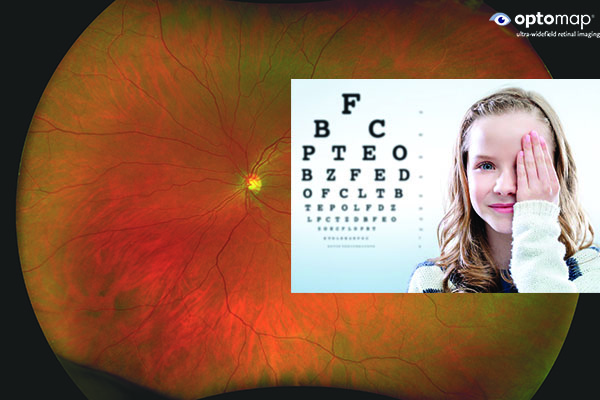
Optomap is an innovative new technology that gives eye doctors the ability to perform ultra-wide retinal imaging that is far superior to what can currently be achieved using conventional retinal imaging options. In contrast to conventional retinal imaging, Optomap captures at least 50% more of the retina in a single capture, and with Optomap’s multi-capture function, up to 97% of the retina can be viewed. This gives eye care professionals greater opportunity to monitor the health and condition of patient vision.
Why is Optomap important?
Optomap is another great preventative eyecare technology tool. By allowing your eye doctor to have a comprehensive view of your retina, they will be able to detect any developing eye diseases early on, before they have a detrimental impact on your vision and day to day life. Not only can Optomap detect eye conditions such as retinal holes, retinal detachment, macular degeneration and diabetic retinopathy, but it can also be used to identify some general health conditions such as cardiovascular disease, stroke and cancer.
What to expect from Optomap scanning
Optomap is a fast, painless and non-invasive procedure that is suitable for patients of all ages, even children and pregnant women. Many patients require their eyes to be dilated ahead of the scan and will be given eyedrops which will widen their pupils and make it easier for the camera to see the structures inside the eye. Pupil dilation is painless, but patients may feel more sensitive to light both during their Optomap scan and afterwards for up to 24 hours. You may also have slightly blurred vision for a few hours. Once your eyes are dilated, you’ll be sat down and asked to look into a small device that will take the pictures of your retina. A short flash of light will let you know that the image has been taken, and the entire imaging is over in just a few seconds. The results will be sent digitally to your eye doctor who will then evaluate them. The results will also be stored on your personal optical record for future information.
If you would like more information about what is involved in Optomap, or to schedule an appointment for this effective screening technology, please contact our eyecare team.
Optomap FAQ
Q: How long has optomap been available?
A: optomap was given clearance to market by the Food and Drug Administration (FDA) in 1999.
Q: How many offices have this technology?
A: There are over 27,000 installed devices worldwide.
Q: Is optomap as comprehensive as the old way I had my eye examined?
A: optomap gives your doctor a comprehensive view that was previously unavailable, and adds to your doctor’s greater ability to diagnose the health of your eye.
Q: How soon will the doctor see the results?
A: The doctor can review the results with you today.
Q: What does optomap tell the doctor?
A: optomap allows the doctor to assess your ocular and overall systemic health.
Q: Why is it important for the doctor to look at the retina?
A: The sensitive tissue that makes up the retina is susceptible to a variety of diseases, and it is essential to catch any problems early in their progression to avoid vision loss.
Q: Is this the best exam?
A: Your doctor intends to give you the best exam possible. That is why they want to include optomap as part of your comprehensive exam.
Q: If I don't have an optomap exam, will I still get a good exam?
A: Of course! Your doctor is still going to give you a good exam. However, you should know that you will be depriving your doctor of a tool that has proven vital in helping doctors detect problems earlier, and you will not have the opportunity to learn about your ocular health.
Q: What age groups are candidates?
A: optomap is recommended for patients of all ages.
Q: Can my child be tested?
A: Yes.
Q: Can I wear my contact lenses?
A: Yes.
Q: Will it tell me if I have cataracts?
A: No, the optomap is looking at the back of your eye, and cataracts are a problem that occur in the front of your eye. optomap can assist your eyecare professional in detecting conditions such as Diabetic Retinopathy, Hypertensive Retinopathy, Retinal Holes, Tears and Detachments, Macular Degeneration, Malignant Melanomas, and many other retinal disorders.
Q: How long will an optomap take?
A: An optomap image can be captured in less than half a second per eye.
Q: I don't have any complaints; I see well, why should I get this?
A: Most eye disorders do not cause pain or other symptoms. Also, when detected early enough, many retinal problems can be treated to avoid vision loss. However, once a retinal problem has caused a loss of vision, it is rarely reversible. Early detection is vital to preserving good eye health.
Q: I have a family history of diabetes, should I have this done? Why?
A: It is particularly important for people who are at risk for diabetes to have an optomap since they are more prone to problems with the retina that could lead to vision loss.
Q: Does this mean I will not be dilated? My doctor has told me I always need to be dilated!
A: The reason your doctor told you that is because before optomap there was no technology available that gave the doctor a comprehensive view of your retina – now that optomap is available, it is possible that dilation may not be required. Dilation is a tool that your doctor may also use to evaluate your retina.
Q: Can I drive afterward?
A: Optomap will NOT blur your vision or make you sensitive to light. However, if as above, you are dilated in combination with optomap, we recommend that you not drive for 1 – 2 hours.
Q: Does this hurt?
A: Not at all, the optomap should be very comfortable for you.
Q: Can taking an optomap cause any damage?
A: No, optomap is a safe procedure.
Q: How often is it recommended to have an optomap done?
A: optomap should be part of every comprehensive eye exam, and you should have your eyes completely examined once per year. Note: May vary for diabetic or other patients who have known pathology and are being managed by the doctors.
Q: Can I have a copy of my test?
A: NOTE: depends on practice procedures. – Yes, your eyecare professional can either e-mail you or print a copy of your optomap. They can keep it as part of your permanent medical record.
Q: I'm pregnant; can I have the test done?
A: Yes.
Q: Is it covered by Insurance?
A: Most vision coverage plans do not offer coverage for advanced diagnostic screening, although there are some that will contribute to the procedure.
Quick Links
Helpful Articles

All Eye Care Services
Find personalized eye care excellence with our comprehensive services. From eye exams to advanced diagnostics, trust us for all your vision needs.
Keep In Touch
For non-urgent questions or to learn more about our services, contact us today!

MARLO
Need to order contacts? Try our user-friendly MARLO portal & have your contacts shipped directly to your home or office!
Quick Links
Contact Info
Hours of Operation
- Monday 9:00am - 6:00pm
- Tuesday 9:00am - 6:00pm
- Wednesday 9:00am - 6:00pm
- Thursday 9:00am - 6:00pm
- Friday 9:00am - 6:00pm
- Saturday Closed
- Sunday Closed
- Monday
- Tuesday
- Wednesday
- Thursday
- Friday
- Saturday
- Sunday
- Monday
- Tuesday
- Wednesday
- Thursday
- Friday
- Saturday
- Sunday
© 2026 Vision Source Katy Ranch. All rights Reserved -
Accessibility Statement
-
Privacy Policy
-
Sitemap
Managed and Designed by 